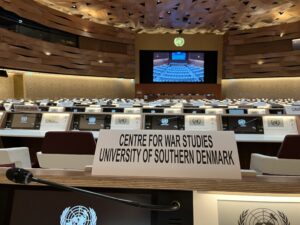
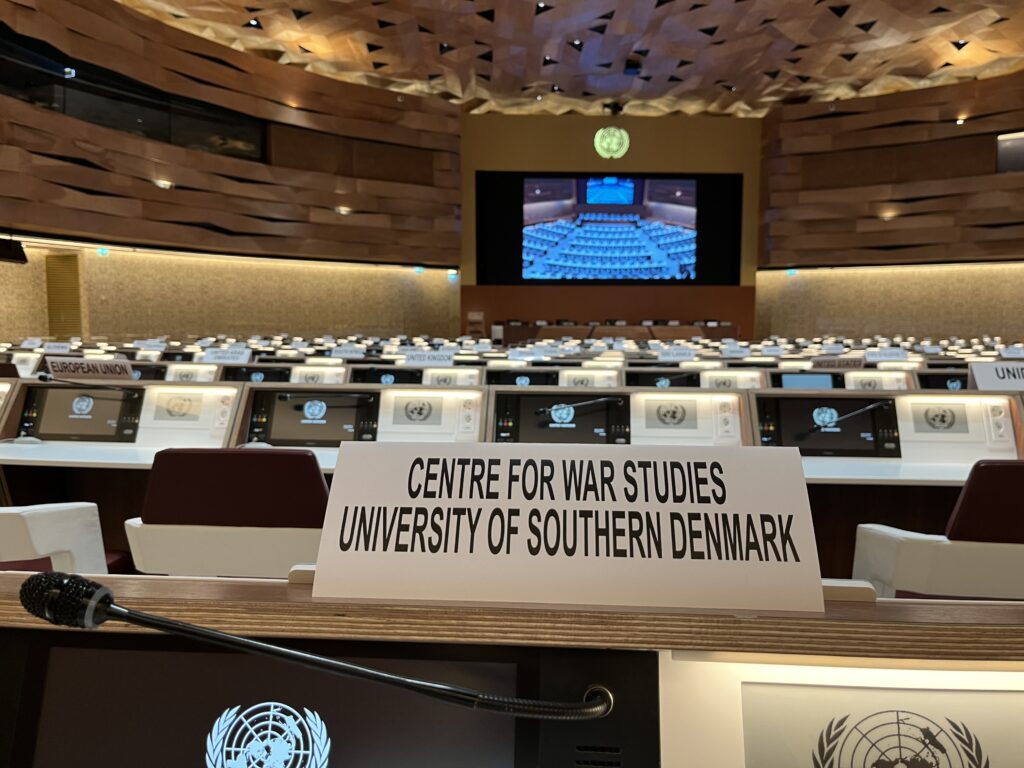
From 15 to 17 June 2026, the United Nations (UN) Office for Disarmament Affairs in Geneva hosted informal exchanges on AI in the military domain and its implications for international peace and security. These consultations followed the UN General Assembly resolution 80/58 adopted in 2025. The resolution mandated holding discussions on various uses of AI in the military domain beyond the use case of lethal autonomous weapon systems (LAWS), which have been the focus of the global debate for more than a decade.
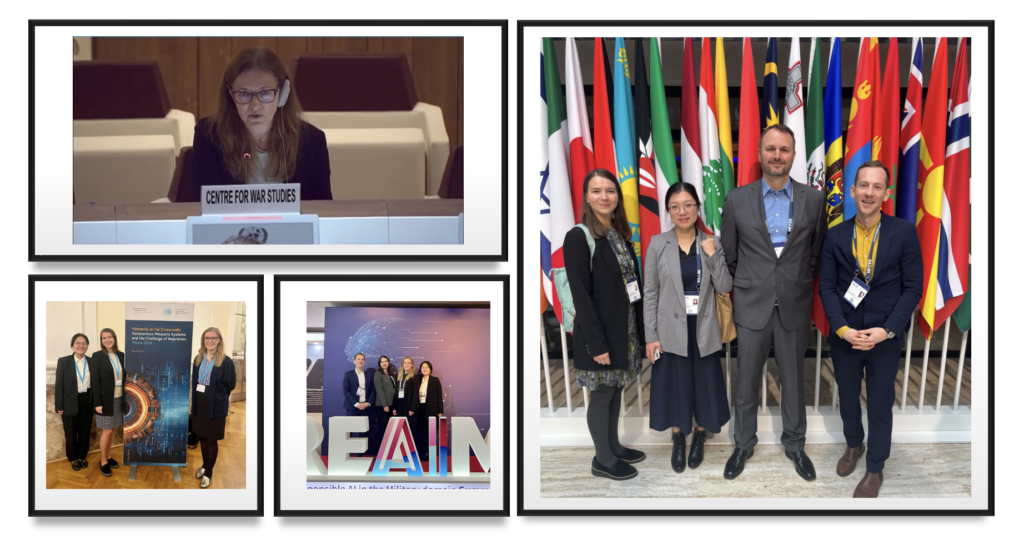
As part of the ERC AutoNorms project, I had the opportunity to attend, observe, and participate in not only these informal consultations, but also other UN processes (notably, the Group of Governmental Experts on LAWS in Geneva); multi-stakeholder platforms such as the Responsible AI in the Military Domain (REAIM) summits in The Hague, Seoul, and A Coruña; as well as various international, national, and regional processes.
Based upon these experiences, in this blog post I first reflect upon the evolution of the policy debates on AI in the military domain and how AutoNorms contributed to them. Second, I offer some brief thoughts on the challenges and opportunities of transferring academic research projects into the policy world. I argue that while involvement in policy debates is not a straightforward process, it is ultimately beneficial for both researchers and policymakers.
AutoNorms and Policy Debates on Weaponised AI
AutoNorms has been primarily a research project focused on theoretical innovation (see AutoNorms Principal Investigator Ingvild Bode’s blog post on the key analytical take-aways), based on the collection and analysis of extensive empirical material across the cases of China, Japan, Russia, and the United States (US). At the same time, the AutoNorms team found it critical to translate our research findings beyond the academic realm.
One reason for this approach is that AI in warfare has become a prominent topic of societal, political, and legal debate. In March 2021, only months after AutoNorms began, a UN report claimed the use of a Kargu-2 loitering munition in a fully autonomous mode during the civil war in Libya. Russia’s ongoing full-scale invasion of Ukraine, the latest phase of the Israel-Hamas war, and the US’ and Israel’s war on Iran have only reinforced the political and societal attention paid to uses of various AI techniques in armed conflict.
We found it important to engage with these debates by disseminating our research to policymakers, diplomats, civil society, industry, and the broader public. We have done this by publishing policy-oriented reports and weapon systems databases; contributing to media articles and outlets in English, French, German, Danish, Mandarin, and Spanish (among others); producing a series of accessible blogs; engaging in Track-Two dialogues; as well as delivering guest lectures to various audiences including the International Committee of the Red Cross, the US Naval Academy, and the European External Action Service. Our team also submitted both written and oral evidence to the UK Parliament, the UN Secretary General, and the GGE on LAWS. In 2025, our submission was included in the UN Secretary General’s report on AI in the Military Domain and Its Implications for International Peace and Security.
In recent years, the global debate on AI in the military has broadened into two directions which allowed the AutoNorms project to contribute with its research findings.
Human-Machine Interaction from LAWS to AI in Decision-Making
First, policy discussions are increasingly paying attention to the use of AI systems as part of different applications, not only in weapon systems. For example, all REAIM Summits so far have covered the implications of developing and using AI in various processes beyond the case of fully autonomous weapon systems (that select and engage targets without human intervention). At the informal exchanges held in June 2026, meanwhile, delegations mentioned AI in nuclear command and control and in cyber operations.
Many ways of employing in AI do not officially ‘replace’ humans in the use of force. Nevertheless, they are important to examine to fully grasp how practices of human-machine interaction form norms on the use of force—as our research on AI in decision-support systems (DSS) showcases. The reported uses of AI DSS in Gaza, Ukraine, and more recently Iran, highlight the urgency of discussing existing processes of integrating AI into the use of force, rather than futuristic ‘killer robots’ inspired by science-fiction.
Considering the Lifecycle of AI Systems
Second, debates are increasingly considering the lifecycle of AI systems, starting from before their development and going through design, development, procurement, testing, use, and post-use review or decommissioning. The informal exchanges in Geneva, for instance, prominently featured lifecycle-based approaches and were even structured based on lifecycle stages. The AutoNorms team has been critical in contributing to the take-up of the lifecycle approach in the policy process, for instance via Ingvild Bode’s participation in the IEEE SA Research Group on Issues of Autonomy and AI in Defense Systems and the Global Commission on Responsible AI in the Military Domain (GC REAIM).
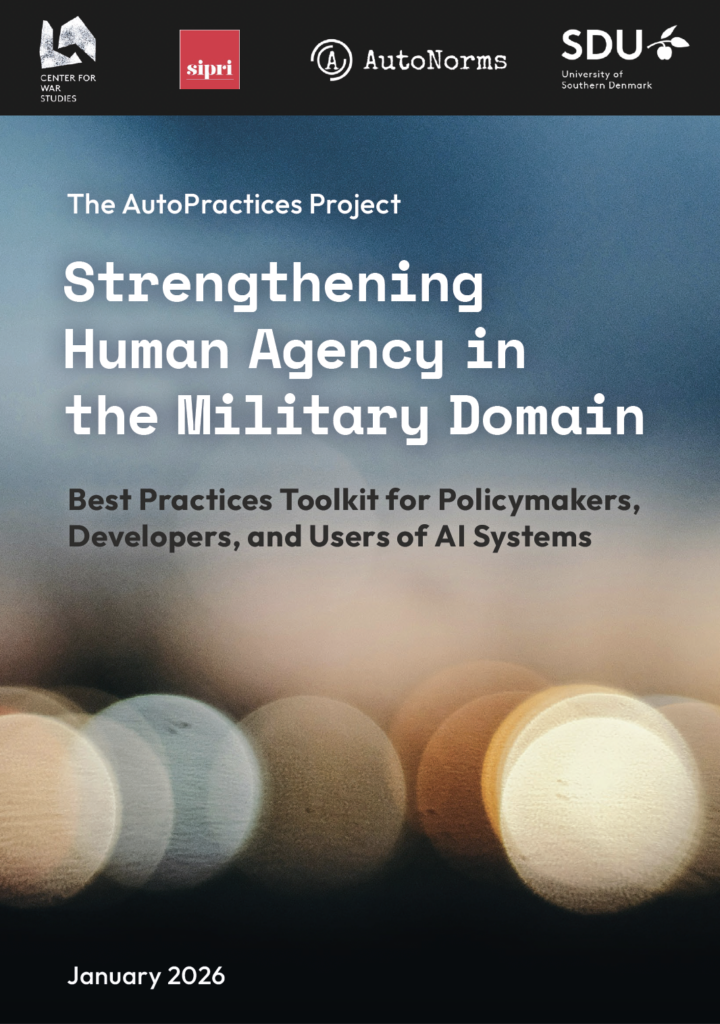
In 2026, we have concluded the policy-oriented AutoPractices project, funded by an ERC Proof of Concept grant and based upon AutoNorms. This project’s main output, a toolkit of best practices to sustain the exercise of human agency across the AI lifecycle, is oriented at policymakers, developers, and users of military AI systems. AutoPractices forms an appropriate conclusion to AutoNorms as it highlights that there are practices that can make positive norms on the human role in the use of force. At the same time, AutoPractices opens up further pathways for research on practices to sustain the norm of human control in the use of force, for example via capacity building efforts to help actors with different levels of resources available to implement those practices.
Lessons from Engaging in Policy Debates
Being involved in policy debates as researchers is not always a straightforward process. For instance, there is the challenge of finding the right language to reach various audiences and conveying the policy implications of our research findings in the most efficient way possible. In our case, this meant not only reflecting about the practices that could ensure positive norms on the human role in the use of force but also communicating them in a format that speaks to actors such as diplomats, militaries, industry, think tanks, or civil society. In other words, in a format that is concrete, clear, and less theoretically oriented.
Another challenge concerns defining one’s positionality in societal debates. Some researchers perceive themselves as neutral observers, others lean towards the activist side, while others adopt some other, often hybrid form of involvement or a more pragmatic approach. Ultimately, it is up to each researcher to decide their position for themselves, but this demands continuous reflections on the types of policy forums or projects one wants to be involved in, as well as the actors one wants to engage with. These reflections are continuous because a researcher’s positionality may change as the world changes too. In my case, Russia’s full-scale invasion of Ukraine and the US’ foreign policy under the second Trump administration have been key in re-shaping my view of the prospects for global governance and the implications of my research for these debates.
But despite these challenges, contributing to national, regional, and global policy processes brings several opportunities, both for a long-term research project such as AutoNorms and the debates on AI in the military domain. First, academic contributions allow building networks of expertise on the governance of AI in the military domain that bring together scholars and practitioners. It is thanks to these networks that we were able to conduct the AutoPractices project. In my experience, such collaborations are beneficial for both sides. Based on feedback we have received, actors from the policy world appreciate the fact that researchers can do a deeper dive into the topic, for instance by compiling empirical databases and drawing key takeaways from empirical material. Meanwhile, as researchers, we get the opportunity to go beyond theoretical reflections and adjust our assumptions about critical ongoing processes in the fields of technology, diplomacy, and industry.
Second, exchanges between theoretical innovation and the policy world are beneficial for developing future research projects that might be more applied, such as AutoPractices, or oriented at solving particular problems. One of my key take-aways from the ERC AutoNorms project is that evidence-based research contributions highlight the variety of societal risks of integrating AI into defence, and increase the prospect of these risks being at the very least debated, whether at parliaments, governments, the UN, the media, and beyond. Building bridges between research and policy and broader debates is particularly valuable at a time when AI development is being prioritized by governments and industry around the world, often without sufficiently considering the multi-faceted risks.
Recommended AutoNorms outputs for further reading
- Nadibaidze, A. (2025). Governance of AI in the Military Domain: International Law, Norms, and Ways Forward. In Conflict, Oxford Intersections: AI in Society. Oxford: Oxford University Press.
- Nadibaidze, A., Bode, I., and Zhang, Q. (2024). AI in Military Decision Support Systems: A Review of Developments and Debates. Odense: Center for War Studies.
- Nadibaidze, A. (2024, 29 November). Do AI Decision Support Systems ‘Support’ Humans in Military Decision-Making on the Use of Force? Opinio Juris.
- Nadibaidze, A. (2023, 30 March). ‘Responsible AI’ in the Military Domain: Implications for Regulation. The AutoNorms Blog.
- The AutoPractices Project. (2026). Strengthening Human Agency in the Military Domain: Best Practices Toolkit for Policymakers, Developers, and Users of AI Systems. Odense: Center for War Studies.