Guest post by Ruofei Wang
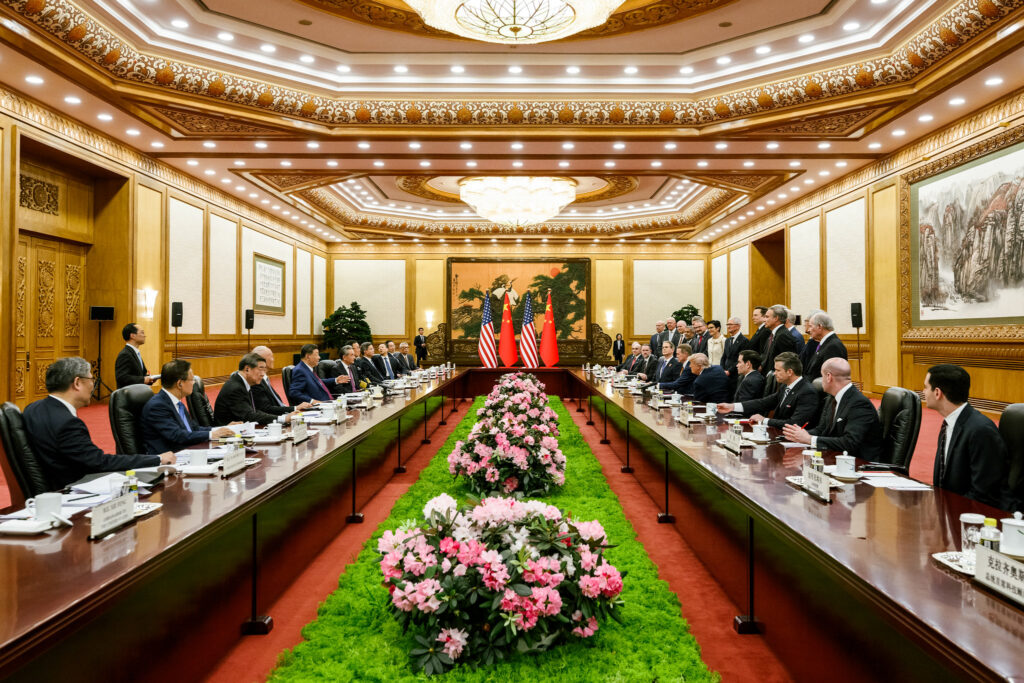
What role can diplomacy play in managing the competitive dynamics and cooperative potentials between the United States (US) and China—the world’s two biggest AI and military superpowers—on governing AI? The landmark Trump-Xi Summit in May 2026 marks a historic moment in US-China relations, amid the increasingly fierce AI, defence, and military global arms race. This Summit featured the first US presidential visit to China in nine years, during which both presidents discussed key issues around US-China relations and global challenges. The key consensus from the Summit on the shared goal of achieving ‘strategic stability’ signals that cooperation and competition can potentially co-exist between the two. The Summit showcases that official, great power diplomacy can play a pivotal role in setting strategic directions for key issues at the table, including AI, semiconductors, and military affairs.
I argue that advancing effective US-China AI governance would require looking beyond great power diplomacy as well as leading state actors and tech giants at the highest level. Hybrid forms of diplomatic processes with meaningful inputs from both state and non-state actors, especially scientists, academics, and civil society, will be central to turning the high-level, political ideas—such as ‘strategic stability’—into concrete, policy actions. In this blog, I unpack the strategic implications of the Summit, identify lessons that could be learned from past and ongoing developments, and envision a future where competition and cooperation can co-exist between the US and China on governing AI.
The Trump-Xi 2026 Summit: Strategic Implications for AI, Chips, and Military Affairs
The 2026 Summit builds on the foundation laid by the Busan meeting between Presidents Donald Trump and Xi Jinping in late 2025. At the Busan meeting, the US and China decided to convene regular, continued exchanges on urgent topics including AI, semiconductors, and military affairs. Although issues around AI were not explicitly addressed, the outcomes of the Trump-Xi 2026 Summit have strategic implications for US-China AI governance. Below, I look into how the high-level political consensus reached, key actors accompanying the state visit, and relevant developments following the Summit together contribute to these strategic implications.
At the strategic level, the Summit sets an overall stabilising tone for US-China relations amid growing technological, economic, and geopolitical competition between the two. President Xi raised several critical questions at the Summit, including whether the US and China can “overcome the Thucydides Trap, meet global challenges together, and provide greater stability for the world”. The key political consensus reached by Trump and Xi on building a constructive relationship characterised by ‘strategic stability’ signals that cooperation and competition can potentially co-exist between the two.
Meanwhile, key actors invited to the Summit along with Trump and Xi show that issues at the intersection of emerging technologies, AI, chips, and military affairs are of prominence. At the tech industry level, CEOs of Big Tech companies such as Elon Musk (Tesla) and Tim Cook (Apple) visited China with Trump, along with Jensen Huang (Nvidia) following a last-minute invite. At the state level, Pete Hegseth, the US Secretary of War, and Dong Jun, the Chinese Defense Minister, were one of the key officials at the diplomatic table on 14 May 2026. The presence of Hegseth, as the first American defence chief accompanying the US president on a state visit to China since Richard Nixon’s visit to China in 1972, marks a diplomatic milestone in defence, security, and military relations between the US and China.
The Summit also advanced future US-China diplomatic engagements on AI and the military affairs, especially in establishing official channels of communication. Following the Summit, the US and China agreed to convene government-to-government dialogues on AI. Meanwhile, the two resumed military safety talks after the Summit—US and Chinese militaries met in Hawaii in late May 2026, where both sides discussed measures to improve air and maritime safety and security, according to the People’s Liberation Army (PLA) navy. Although the specific arrangements of the official communication channels on AI and military affairs are still under development, these setups could benefit from a combination of scientists’ inputs with in-depth domain, country knowledge, as well as practitioners’ contributions of on-the-ground political, practical experience. The official exchanges on AI and military affairs could also pave the way for less formal, more technical exchanges between two sides, building on existing Track 2 and Track 1.5 dialogues.
Great Power Diplomacy: A Historical Perspective on US-China Relations and AI Governance
Although it is not the first time that a US president visited China in the past decades, the Summit bears similar historical importance compared to Richard Nixon’s 1972 visit to China in shaping US-China relations. Nixon’s meeting with Mao Zedong marked the normalisation of the long-strained US-China relations, paving ways for three decades of diplomatic relationships between Washington and Beijing. Nixon’s visit also signalled a paradigm shift in diplomacy where “strategic interests” were prioritised over “ideological interests”. In the same vein, Trump’s trip to China this year may well have long-term, strategic implications for US-China relations as well as key areas such as AI and military affairs for the decades to come, especially in a new era where great power dynamics differ fundamentally from the Cold War period.
Despite the ability to set high-level, strategic priorities, great power diplomacy alone is insufficient at addressing risks associated with AI and military affairs. For the US and China, hybrid, new forms of diplomatic processes will be central to complementing, implementing, and shaping the high-level political agendas and policy priorities of both sides. The diplomatic developments in AI safety, autonomous weapons systems, and military AI, where both China and the US are involved, for example, demonstrate the strengths and limitations of official, great power diplomacy.
There are moments where great power diplomacy helped to build the foundation for ongoing exchanges. At the AI Safety Summit 2023 hosted by the United Kingdom Government, participating states including the US and China signed the Bletchley Declaration, showing commitment to addressing risks raised by frontier AI. Although the following summits faced criticism around the safety aspect losing its priority, conversations on AI safety, such as the annually updated International AI Safety Report and the International Scientific Exchange on AI Safety, continue among scientists and civil society organisations where both the US and China play a part. In the same vein, on the sidelines of the APEC Summit in 2024, Presidents Xi and Joe Biden agreed that “humans, instead of AI, should make decision over the use of nuclear weapons”. Subsequently, the conversation on AI and nuclear safety continued in Track 2 dialogues between US and Chinese experts in 2025 and 2026.
There are also moments when great power diplomacy displayed less effective progress and outcomes. At the UN Group of Governmental Experts (GGE) on lethal autonomous weapons (LAWS), CCW high contracting parties have been meeting for a decade since its establishment to discuss issues related to emerging technologies in the area of LAWS, in which both the US and China play a role. Nonetheless, despite the UN process offering a platform for negotiation and communication, progress on reaching consensus and constructive outcomes is limited.
In the space of military AI, the 2023 REAIM Summit—Responsible AI in the Military Domain—involved both US and Chinese representatives. However, both the US and China opted out of the REAIM Summit’s joint declaration in 2026, underlining the competitive dynamics of US-China relations, military AI rivalry, and national security concerns. Meanwhile, as argued by AutoNorms’ Qiaochu Zhang and Ingvild Bode, “different societal visions of the good life” that underpin “US and Chinese approaches to governing AI in the military domain” make cooperation far more challenging beyond “interest-based competition”. We thus need to seek alternative diplomatic channels and points of engagements between the US and China to secure forms of governing AI in and beyond the military domain.
A Path Ahead: Where Competition and Cooperation Can Co-Exist in Governing AI
The Trump-Xi Summit has laid out a solid foundation and strategic directions for the continued engagements between the US and China on critical areas such as AI, chips, and military. Under the surface, however, the geopolitical and competitive dynamics are far more complex. After the Summit, the Trump Administration held off blacklisting Chinese AI startup DeepSeek and memory chipmaker ChangXin Memory Technologies, among more than 100 other Chinese companies, to manage tensions with Beijing.
Nevertheless, warnings of national security risks and fears of losing the AI arms race with China persist in US policy circles. In the meantime, while the Trump Administration recently barred foreign access to Anthropic’s most advanced AI models, Chinese AI companies are pushing for improved AI model performance based on large-scale, open-source, and low-cost strategies. Critical technologies like AI have long been focal points of competition in political, economic, and military power. Yet, the competitive mindset overlooks current and future shared technological barriers, challenges, and risks that neither the US nor China can overcome alone.
The US and China should be capable of finding a path where competition can coexist with cooperation to address common risks and bring shared benefits. On governing AI, both American and Chinese scholars share the view that the US and China can work together and that AI safety could be one of the anchoring points. For instance, US-based experts Christina Knight and Scott Singer argue that “cooperation” between the US and China “is necessary” and “possible”, adding that both sides can benefit from “narrow, stable conversation on global AI risks” by “practising safe sharing”. Meanwhile, Xiao Qian, Deputy Director of the Center for International Security and Strategy at Tsinghua University, contends that both sides “share similar concerns about the future trajectory of AI” and that “AI safety cooperation serves the interests of two countries” in tackling “systemic risks”.
In practice, advancing effective US-China AI governance where competition and cooperation can co-exist requires looking beyond great power diplomacy as well as leading state actors and tech giants. On the one hand, high-level, formal diplomacy and technical, informal exchanges can complement one another. While official, formal diplomatic engagements help to set strategic, long-term priorities, hybrid forms of discussions with participations of non-state actors, ideally in less formal or public settings, are central to building relationships, trust, and confidence between two sides.
The US and China have been part of such Track 1.5 and Track 2 engagements, ranging from the Code of Conduct on AI in military systems where stakeholders outlined key principles on AI-enabled weapon systems, to the International Dialogue on AI Safety where scientists identified ‘red lines’ on AI risks, as well as many other ad-hoc and longer-standing conversations such as the Brookings-Tsinghua Dialogue on AI and national security. The question here is whether such engagements and channels can be sustained to offer a safe, stable space for much needed conversations and to find ways to turn high-level ideas into concrete policy actions moving forward.
On the other, state actors, tech giants, and other non-state actors play equivalent important yet distinct roles in advancing US-China governance. Whereas state actors and tech giants bring high-level, strategic political and economic issues to the table, other non-state actors, especially scientists, academics, and civil society organisations, are central to advancing progress on governing AI in and beyond the military domain. Scientists working in industry and academia, for example, not only have in-depth technical understanding of the very core of AI technologies but are also well positioned to see the bigger picture, longer-term implications that may be missed during the AI and military arms race—their role as intermediaries, mediators, and bridge builders is indispensable.
As tech titans are gaining increased diplomatic power from the Trump-Xi Summit to the G7 Summit this year, experts working behind the scenes also deserve a seat at the diplomatic table. The AutoNorms team, for instance, has been working on both the technical and strategic aspects of AI governance in and beyond the military domain, including in relation to the US and China, while actively participating in various policy processes. While AI continues to advance, AI governance has increasingly become a global mission; the US and China are not the only actors in the picture. Nonetheless, as the world’s top AI and military superpowers, the US and China bear the responsibility to work together on governing AI moving forward.
About the author
Ruofei Wang is a PhD Research Fellow at the Center for War Studies, University of Southern Denmark. Funded by the Future of Life Institute, her PhD research investigates the role of multi-track diplomacy in advancing US-China AI governance in and beyond the military domain. She has worked in both policy and research on AI, emerging tech, and Internet governance. She previously studied public policy at Oxford University and technology governance at the London School of Economics.