
Ingvild Bode and Anna Nadibaidze represented the AutoPractices project at the Informal Exchanges on Artificial Intelligence in the Military Domain and its Implications for International Peace and Security. The exchanges were held from 15 to 17 June 2026 in Geneva and organised by the UN Office for Disarmament Affairs (UNODA).
Statement during session 5
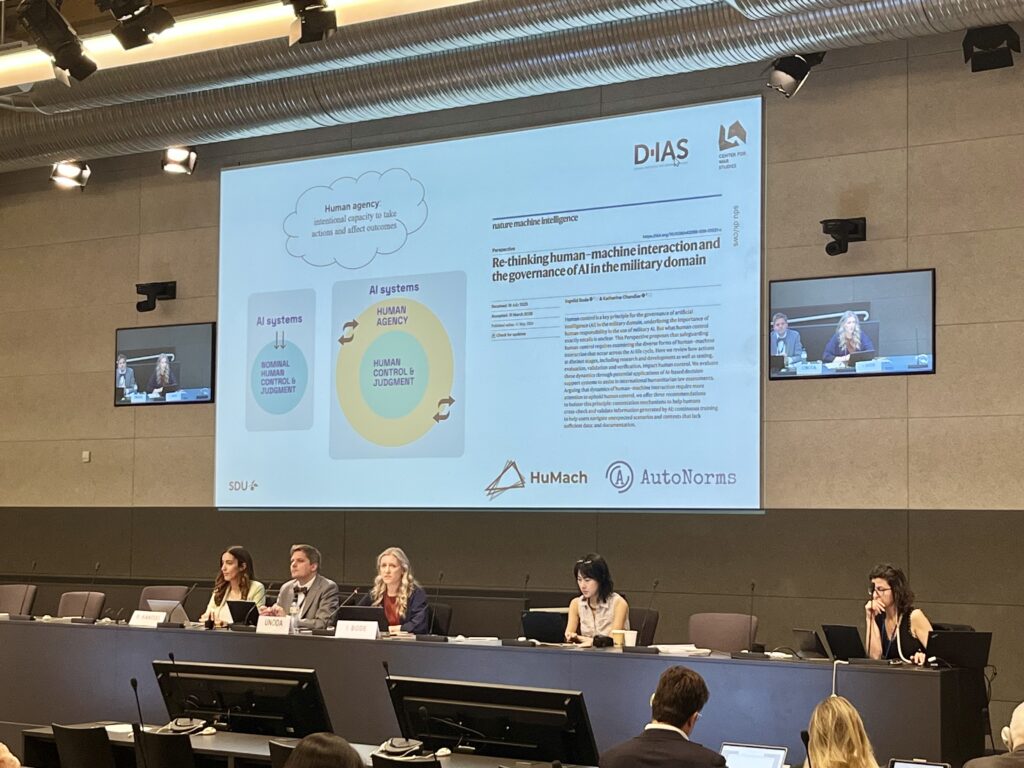
On 16 June 2026, Ingvild Bode delivered the following statement during session 5 “The Life Cycle of AI in the Military Domain (Part 2)”. The remarks and slides are also available on the UNODA Meetings website.
I will speak about two issues in my brief intervention: (1) first, I will draw attention to an under-recognized dimension of human judgment and control – namely human agency; and (2) second, I will demonstrate how thinking about this shapes concrete implementation pathways at the lifecycle stages of deployment and use.
(1) Human agency and human-machine interaction
Let me speak about an under-recognized dimension of human judgment and control – namely human agency, which I understand as the intentional capacity to take actions and affect outcomes. Exploring human agency recognizes that there is a two-sided relationship between humans and AI systems – especially at the deployment and use stage of the lifecycle.
Human agency has important implications for the ability to exercise control of AI systems, particularly with respect to relevant legal and ethical frameworks. In the international debate about AI in the military domain, we have seen the emergence of a requirement for the sufficient capacity to exercise human agency as a possible condition for compliance with international humanitarian law.
The GGE on LAWS rolling text, for example, stipulates specific measures to implement human judgment and control as well as to promote human responsibility and accountability in the use of LAWS (GGE on LAWS 2026, para.20).
While this is not explicitly mentioned, these stipulations appear to be designed to ensure that human judgment and control, especially in the context of deployment and use, does not turn nominal.
The notion of nominal human control describes a situation where humans appear to be exercising important legal, safety, and ethical functions in the deployment and use of AI systems but actually lack the time, information, or cognitive capacity to perform these functions. Here, humans engage in cognitive off-loading and over-rely on AI for complex tasks. This process is linked to “automation bias”, the over-reliance on the AI’s output and a failure to catch its mistakes.
The simple presence of humans at the moment of deployment and use is therefore not sufficient to guarantee human judgment and control. This is perhaps best illustrated through considering the case of AI decision support systems. In the case of AI DSS, human operators have the final say over the verification and validation of targets. But this simple presence does not guarantee the exercise of human judgment and control – it does not consider how the human agency by those humans in the loop is exercised and affected by various dynamics of human-machine interaction.
Building on this, I argue that the risk of nominal human control can be countered if we integrate human agency into our thinking about governing AI systems in the military domain.
(2) Implementation pathways
In the second part of my intervention, I want to raise some concrete implementation pathways arising out of thinking about how the exercise of human agency conditions human control and judgment. The two implementation pathways that I sketch come from an international research project that I led, the European Research Council funded AutoPractices project, where we worked with a diverse set of stakeholders to co-produce a best practices toolkit around strengthening human agency when using AI systems in the military domain.
(1) Integrate feedback, communication and contestation mechanisms that connect human actors at the deployment/use stage with those at earlier lifecycle stages. Ongoing feedback loops and communication channels among all participants at various life-cycle stages help people understand how AI systems work and how these are used in specific contexts. This improves transparency and strengthens human accountability. Human actors at the deployment and use stage should have the opportunity to cross-check the outputs of AI systems with other sources of data and intelligence. This cross-checking exercise helps humans to critically assess and potentially challenge AI outputs. It also safeguards against deskilling and cognitive erosion. These contestation mechanisms would raise human user awareness of known and potential limitations and aid them in understanding when the system is not working as planned. The impact of this practice ultimately rests on maintaining an organizational culture that is open to feedback and exchange.
(2) Include consistent documentation to transmit knowledge, concerns, and risks. This should include establishing documentation channels to transmit knowledge, concerns or risks across the chain of command. Maintaining such consistent records and documentation is vital to ensure transparency of how responsible individuals or teams use AI systems for certain functions. What both of these pathways highlight is also that the deployment and use stage cannot be thought of in isolation from the earlier lifecycle stages. The two pathways I sketched require throughlines of documentation and feedback loops.
Side event on assurance, accountability, and autonomy
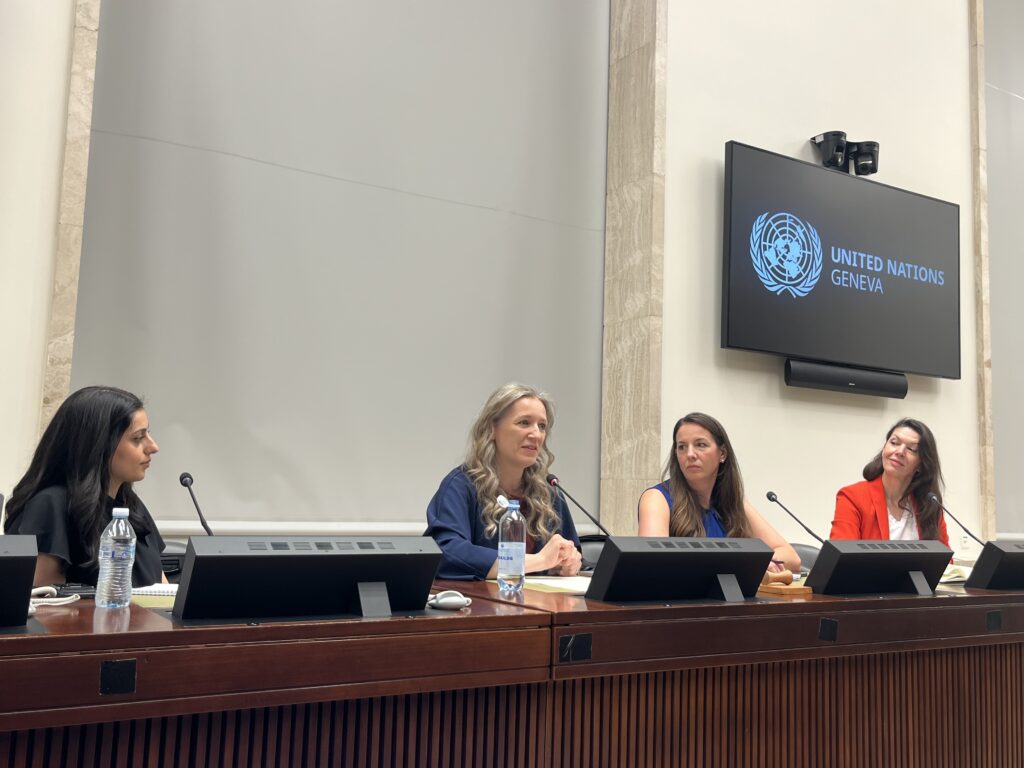
On 16 June, Ingvild Bode also spoke the side event “Assurance, Accountability, and Autonomy: Responsible Military AI Lifecycle Governance” organised by the Responsible by Design Institute. The side event featured a panel discussion together with Jessica Dorsey (Utrecht University), Zena Assaad (Australian National University), and Elke Schwarz (Queen Mary University of London).
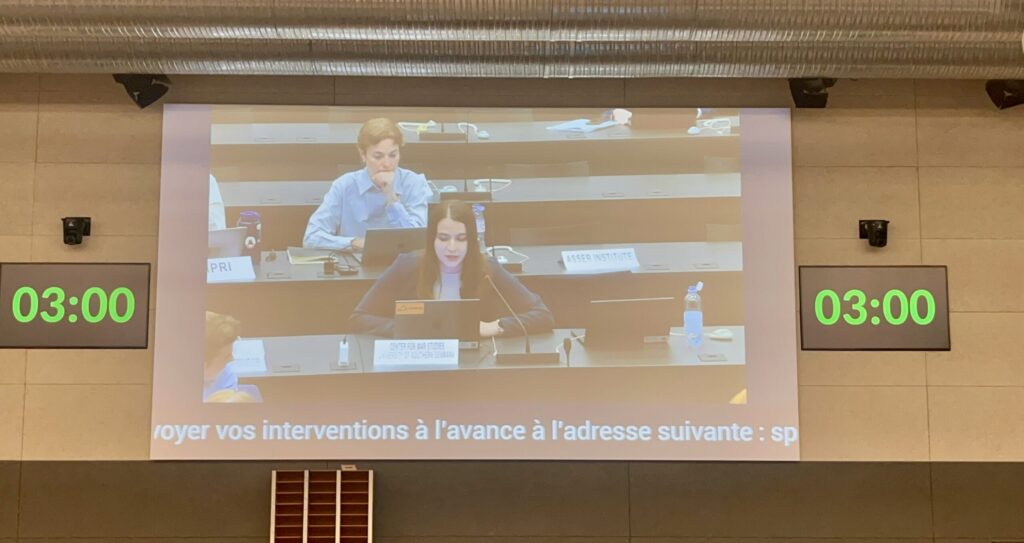
Statement during session 10
On 17 June 2026, Anna Nadibaidze delivered the following statement on behalf of the AutoPractices project during session 10 “Information Exchange on Other Initiatives Related to AI in the Military Domain”.
Thank you, Chair, for giving me the floor.
I am speaking on behalf of AutoPractices, an international research project hosted by the Center for War Studies at the University of Southern Denmark. This intervention responds to one of the guiding questions of this session, namely “Are there relevant initiatives on AI in international peace and security outside the UN auspices?”.
Earlier this year our delegation concluded the AutoPractices project, which was also mentioned yesterday during session five. The project’s main output was published in collaboration with the Stockholm International Peace Research Institute. It is a toolkit of best practices and measures to sustain the exercise of human judgement and control across the lifecycle of AI systems in the military domain.
The best practices in this toolkit have been identified by 49 stakeholders who represent different disciplines and regions of the world. The practices concern personnel at various levels of military command, as well as actors involved in the development, design, procurement, and other stages of the lifecycle of AI systems.
This toolkit is intended to complement governance debates happening in and beyond the UN. It provides a bottom-up approach that sketches pathways towards implementing the principle of human judgement and control that is so widely shared and recognized.
We would like to highlight three main takeaways from this initiative.
First, as has also been demonstrated in the last three days, the AutoPractices initiative found that efforts to operationalize the role of human judgement and control should adopt a lifecycle-based approach that considers not only the use of AI systems but also early stages, even prior to the development of AI systems.
Second, the AutoPractices initiative brought together representatives of military, political, legal, and technical backgrounds, among others. As has been mentioned several times in the last days, interdisciplinary dialogues and initiatives are key when it comes to building common understandings of terminology in relation to AI in the military domain.
Third, one potential way forward for informal exchanges, as highlighted by many delegations in this room, could be a focus on capacity building. The AutoPractices initiative found that more precise capacity-building measures are needed to support actors around the world that may lack resources or plans to implement practices to sustain the exercise of human judgement and control.
Thank you, Chair and Distinguished Delegates, for your attention.