By Guangyu Qiao-Franco and Qiaochu Zhang
Within the AutoNorms project, China has been a key site for understanding how norms around autonomous and AI-enabled weapons are emerging, stabilising, and being contested. As the project draws to a close, this blog post sets out two key areas of findings from our research: first, it synthesises the major continuities and shifts in China’s position on military AI; and second, it outlines three key takeaways from our research on China’s role in AI governance and human-machine interaction.
Continuity and Change in China’s Position on Military AI
When we began our research on China’s position on military AI, the topic was still largely framed—much like in many other states—as a future-oriented issue. However, within a relatively short period, AI has become increasingly integrated into China’s military doctrine and operational systems.
A useful illustration comes from a 2024 PLA documentary series on military modernisation. Across the series, AI capabilities appear repeatedly, from logistics and decision-support systems to more advanced autonomous weapons concepts. This shift is significant, suggesting a movement from conceptual exploration toward practical deployment as part of the PLA’s broader “informatisation” and “intelligentisation” strategy.
Based on our analysis of publicly available material, this transition becomes particularly visible around 2023. Importantly, this evolution in military AI capabilities appears to coincide with changes in China’s diplomatic positioning on autonomous weapons governance.
Between roughly 2016 and late 2022, China was a relatively active participant in international discussions on lethal autonomous weapons systems (LAWS), particularly within the Convention on Certain Conventional Weapons (CCW). By its own diplomatic standards, this engagement was notably proactive. For example, in its 2016 position paper submitted to the CCW Review Conference, China described LAWS as a potential threat to humanity, raised concerns about compliance with international humanitarian law, and supported negotiating a legally binding instrument, drawing parallels with the Protocol on Blinding Laser Weapons.
More recent developments suggest a more cautious and less visibly proactive approach, despite some recent signs of Beijing’s active engagement in informal exchanges and Track-Two dialogues. While China remains highly active in regulating civilian AI and plays a prominent role in global AI governance in non-military domains, its official engagement in military AI governance appears to be more muted. This is reflected in events such as the Responsible AI in the Military Domain (REAIM) summit in Spain, where both China and the United States (US) declined to endorse a joint declaration on military AI. A similar pattern appears in China’s statement at the Thematic Debate on Conventional Weapons during the 80th session of the UN General Assembly First Committee in October 2025, where it reiterated support for a legally binding instrument on military AI, but only “when conditions are mature”.
This qualification is important: it signals support in principle while preserving strategic flexibility in practice. It also reflects a broader framing within China, where AI is still primarily understood as a general-purpose civilian technology central to economic development, industrial modernisation, and public services, rather than as a domain defined primarily by military application.
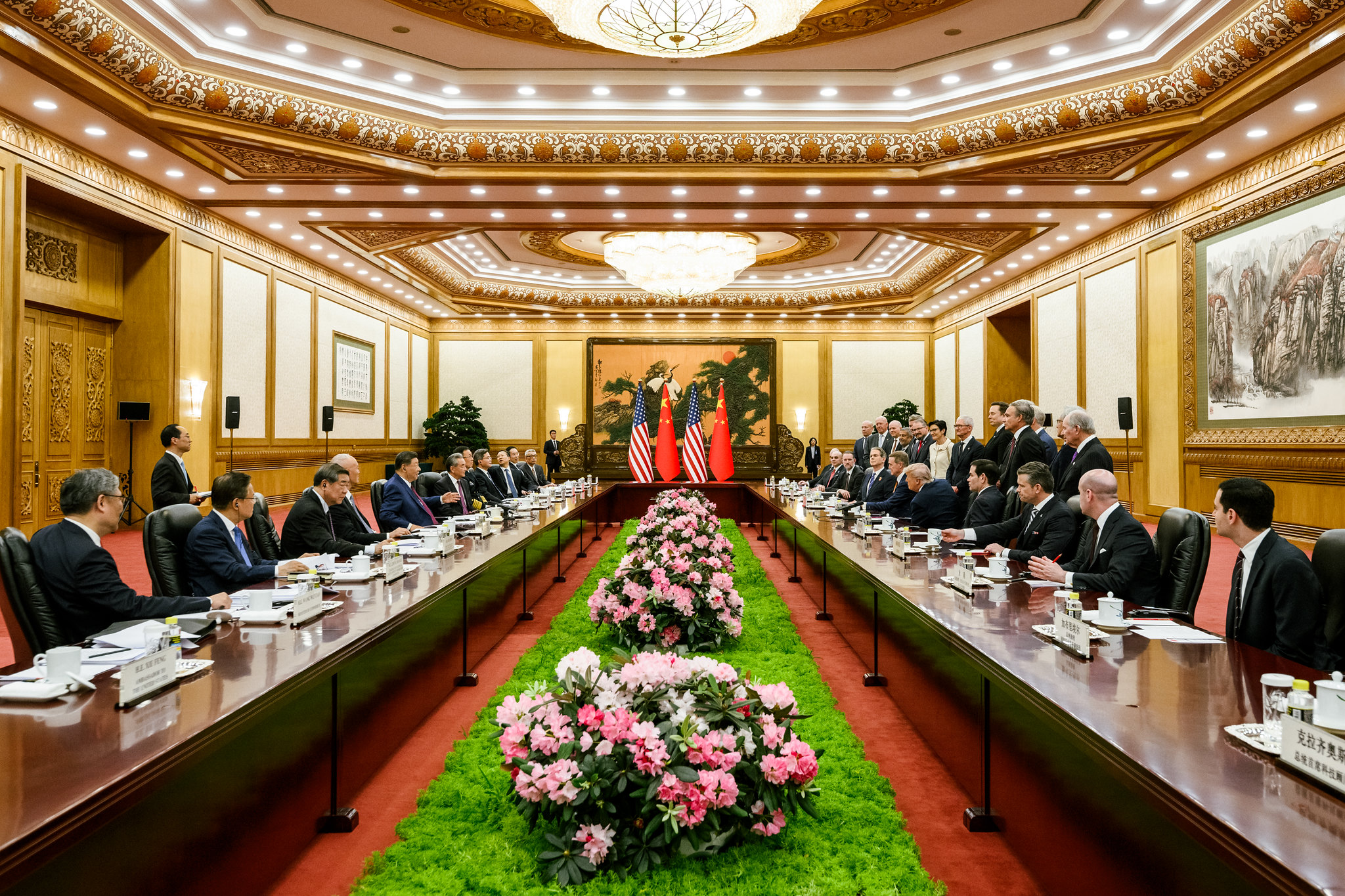
Does this mean China no longer supports regulation of military AI? Not necessarily. China continues to express support for regulation, but its governance strategy appears to be evolving. Rather than prioritising multilateral negotiations, China increasingly favours bilateral engagement, particularly with the US. The recent Xi–Trump summit reinforces this trend, alongside more cautious and reserved participation in multilateral forums.
One plausible explanation lies in the distribution of technological capabilities. China and the US are currently the two leading powers in AI development, particularly in computational capacity, sensor infrastructure, and advanced model development. In a context of intensifying geopolitical competition, both face strong incentives to preserve technological advantages and avoid constraints on capability development.
Three Takeaways from our Research on China’s Approach to AI Governance
Recognising that China’s position on AI governance is neither fixed nor static, we highlight three takeaways from our research so far, while recognising that they may continue to evolve over time. These insights also help challenge several common misconceptions about China’s approach to AI governance.
First, China should not be understood as a unitary actor in AI governance. Different actors within China hold different views about what appropriate AI governance should look like. Their interactions, negotiations, and sometimes competing priorities shape what is presented, and perceived, as the “Chinese” approach to AI governance. While the Chinese government continues to play a central role in shaping China’s AI governance agenda, technology companies and policy think tanks are becoming increasingly influential. R&D actors and technology companies contribute through the design and development of AI-enabled systems and participation in policy consultations. Policy think tanks, such as the Centre for International Security and Strategy at Tsinghua University, shape the governance process through their expertise and involvement in Track-Two diplomacy.
Second, contrary to the common perception that China prioritises AI development over regulation, Chinese policymakers have recognised the ethical and security risks of AI from an early stage and have sought to address them alongside efforts to promote innovation. China’s first national AI policy document, the “Internet Plus” AI Three-Year Action Plan, published in 2016, already raised concerns about privacy and intellectual property rights. The 2017 New Generation AI Development Plan went further, noting that AI could “alter employment structures, impact legal and social ethics, and infringe on personal privacy”. This early recognition of AI-related risks was followed by several major policy documents on AI ethics, including the Governance Principles for New Generation AI – Developing Responsible AI (2019), the Ethical Norms for the New Generation of AI (2021), and the Position Paper on Strengthening Ethical Governance of AI (2022). China’s position reflects a largely utilitarian understanding of AI ethics: ethical and security risks are addressed as conditions for making AI development more sustainable and promoting social well-being.
Third, China’s approach challenges the perception that AI governance is governed by a single set of principles across all sectors. Instead, it follows a dual-track model that reflects distinct security logics in the civilian and military domains. In the civilian domain, AI is closely linked to concerns over social stability and ideological security. This approach is reflected not only in China’s domestic regulatory framework, including through the introduction of one of the world’s first regulatory frameworks for generative AI, but also in its active participation in international norm-setting, especially within the United Nations (UN) system and bodies such as the International Telecommunication Union. China has also promoted its own initiatives and forums, including the Global AI Governance Initiative and the World AI Conference in Shanghai. Through these efforts, China seeks to present itself as a responsible global power and an important agenda-setter in civilian AI governance.
By contrast, in the military domain, China regards AI as a means of strengthening national security and enhancing military capability. As discussed in the previous section, this has led China to adopt a more strategically ambiguous position on the regulation of military AI. For example, China has advanced a restrictive definition of LAWS, limiting the concept to systems characterised by lethality, autonomy, an inability to be terminated, indiscriminate killing, and self-evolution. China has mostly abstained from voting on more specific UN General Assembly resolutions related to military AI, including three consecutive resolutions concerning LAWS—A/RES/78/241 in 2023, A/RES/79/62 in 2024, and A/C.1/80/L.41 in 2025—as well as Resolution A/RES/80/23 in 2025 on AI in nuclear weapons. The sole exception is Resolution A/RES/79/239, which China supported; however, this resolution concerns military AI governance in broader terms rather than specific weapons-related applications.
In conclusion, China’s approach to AI governance should be understood as dynamic, internally diverse, and domain-specific. It is dynamic because China’s position has changed over time in response to technological development and shifting perceptions of risk. It is internally diverse because the Chinese state, technology companies, and policy think tanks all contribute to shaping AI governance, even if they do not do so on equal terms. It is domain-specific because China treats civilian and military AI differently: civilian AI is framed as a governance challenge requiring regulation and international norm-setting, while military AI is increasingly treated as a strategic capability requiring flexibility and caution in accepting binding constraints.
Engagement with China on AI governance therefore should be tailored to specific policy domains and communities rather than premised on a uniform Chinese stance. A more nuanced understanding of how different Chinese actors and sectors perceive AI-related risks and opportunities can help identify areas of convergence while avoiding misplaced expectations about the scope of cooperation.
Recommended AutoNorms outputs for further reading
- Qiao-Franco, G., & Zhu, R. (2024). China’s Artificial Intelligence Ethics: Policy Development in an Emergent Community of Practice. Journal of Contemporary China 33(146), pp. 189-205.
- Qiao-Franco, G., & Bode, I. (2023). Weaponised artificial intelligence and Chinese practices of human–machine interaction. Chinese Journal of International Politics 16(1), pp. 106-128.
- Qiao-Franco, G., & van Beek, A. (2025). China’s Strategy for Global AI Governance. Leiden: Leiden Asia Centre.
- Zhang, Q. (2025). Different fields, different appropriateness? Unpacking emerging normativity in China’s AI governance. Cooperation and Conflict, online first.
- Zhang, Q. (2025). Navigating the In‐Between Space: The Roles of Chinese Think Tanks in Artificial Intelligence Governance. Global Policy 16(3), pp. 494-500.
- Zhang, Q., & Bode, I. (2026). Governing AI in the Military Domain in a Multi-Order World: China, the US, and Visions of the ‘Good Life’. Contemporary Security Policy, online first.